This practice-based research project explores the creative potential of two instruments from SOMA Labs, the PULSAR-23 and LYRA-8. The project’s core involves creating an 8-track experimental electronic music album using these instruments as the only sound sources. The research examines the creative process through the lens of Actor-Network Theory (ANT), investigating interactions between the composer, instruments, audiences and the broader network of influences in electronic music composition.
To frame this practice-based research, the project draws upon Robin Nelson’s principles of Practice as Research (PaR). Nelson (2013) articulates PaR as an approach where practice is central to the research process and serves as a mode of inquiry that generates knowledge. This aligns with the qualitative methodologies underpinning this study, where the practical engagement with the PULSAR-23 and LYRA-8 is not only the subject but also the method of research.
Nelson (2006) explores the challenges and opportunities of PaR, emphasizing the unique knowledge that emerges from artistic practices. This perspective supports the methodological approach of this study, highlighting how the unconventional use of the PULSAR-23 and LYRA-8 in music composition facilitates both creative and research outcomes. By situating this research within Nelson’s framework, the study underscores the legitimacy and rigor of practice-based methodology in academic enquiry.
Vlad Kreimer, the designer of these innovative tools, emphasizes the importance of imagination in the evolution of science and technology. He states, “Our ability to prize the imaginary over the perceptible also deserves its due; it has played a key role in the evolution of science, the vast majority of which resides in the theoretical space” (Kreimer, 2020, P. 11). This philosophy is reflected in the design of the PULSAR-23 and LYRA-8, which encourage intuitive, hands-on exploration rather than rigid, pre-defined structures. This aligns with the project’s aim to defamiliarize the compositional process and foster a dynamic interplay between human creativity and technological affordances.
3.1. Preparation and Techniques
In preparation for the project, extensive practice sessions were conducted to develop familiarity with the instruments, taking place in an informal and domestic setting [C.1]. Techniques like live hand-patching, control and relinquishment exercises, serendipitous patching and free-tuning were developed during these sessions, shaping the subsequent compositional process:
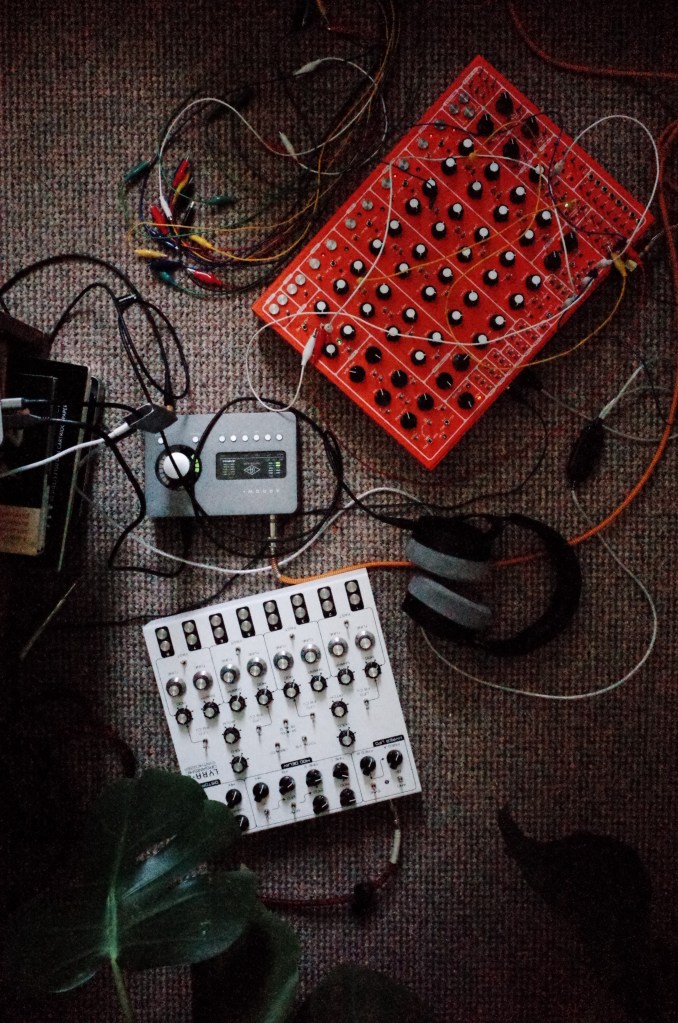
[Appendix C.1 – Composition Environment]
A. Appendix B.1 – Live Hand-Patching: Using the PULSAR-23’s capacitive touch controls, and patch points for real-time manipulation of sounds and textures through touch, not cables, resulting in performative musical artefacts.
B. Appendix B.2 – Serendipitous Patching: Making connections on the PULSAR-23 without specific intention, embracing unexpected feedback loops and novel sonic outcomes.
C. Appendix B.3 – Free-Tuning: Using the LYRA-8’s tune controls on the 8 voices to create chordal relationships and harmonic interactions without a tuner, and by ear, expanding on fixed interval chord structures.
D. Appendix A.1 – Improvisation (Romantic Resonance): Extensive improvisation with the PULSAR-23 in preparation for the project allowed for long, uninterrupted exploratory approaches to music-making. These improvisations were often unexpected but would always teach me something about the instrument’s capabilities.
Nelson’s (2013) concept of praxis as ‘theory imbricated within practice’ is particularly relevant here, emphasizing the mutual reinforcement between theoretical insights and practical engagement. This methodological approach allows for a deeper exploration of how the unique characteristics and affordance of the PULSAR-23 and LYRA-8 shape the compositional process and the resulting musical outcomes.
3.2. Data Collection Methods
i. Audio Recording: The 8 tracks submitted are the complete compositions created using the PULSAR-23 and LYRA-8. In addition to these complete tracks, isolated patches or layers were recorded to showcase specific techniques used during the compositional process. This approach allowed for a detailed examination of how key techniques contributed to the overall compositions.
ii. Visual Documentation: Photos and videos of patch setups and performance techniques were collected to provide additional context. Although the photos primarily depict the patches and environment, they do not show intricate details, rather, they offer a visual reference for the setup. Videos became much more useful in illustrating key methods in action. The video documentation emerged as more effective compared to traditional patch sheets and provided clearer evidence of practice.
iii. Community Engagement Documentation: Interactions with online communities and resources were documented, including insights gained from the SOMA Labs community and techniques learned from online tutorials.
iv. Surveys for SOMA Users: Surveys were conducted to collect insights on creative processes, community engagement and experiences with SOMA instruments. These surveys helped understand the broader impact of instruments on the electronic music community.
v. Listener Feedback Surveys: A survey was conducted to gather feedback on selected tracks, assessing audience reactions and experiences with the music created using the PULSAR-23 and LYRA-8.
vi. Interview with SOMA Labs: An interview was carried out with Thomas Lundberg of SOMA Labs to provide insights into the design philosophy and processes behind the instruments design and use, supported by artists testimonials.
3.3. Data Analysis Framework
The data analysis framework systematically examines the compositional process and resulting tracks, focusing on the interactions and influences of various actors (both human and non-human) involved in the creative process. The analysis draws on Actor-Network Theory (ANT) principles, ensuring a comprehensive understanding of how different elements interact and contribute to the outcomes.
i. Thematic Analysis of Audio Recordings: To identify recurring themes and patterns in the compositions that highlight the influence of the PULSAR- 23 and LYRA-8. Transcribing key segments of the audio recordings, with a focus on moments where the instruments’ unique characteristics and affordances are most evident. The segments will be coded for themes like control relinquishment, serendipitous outcomes, emergent sonic possibilities and defamiliarization.
ii. Reflective Journaling and Patch Documentation: To capture the subjective experience of the composer and the detailed technical setups of the instruments. Analyze reflective journal entries and patch documentation for insights into the decision-making process, the role of the instruments and the evolution of compositional techniques. Code entries for themes such as experimentation, community influence, technology-driven creativity and defamiliarization experiences.
iii. Community Engagement and Audience Feedback Analysis: To understand the broader cultural and community influences on the creative process and the reception of the musical outcomes. To analyze interactions with the SOMA Labs community, focusing on shared techniques, feedback and collaborative influences. Assess audience feedback from surveys to gauge the reception and interpret how listeners perceive the innovations introduced by the instruments.
3.4. Ethical Considerations
All survey participants were informed about the research’s purpose and their consent was obtained. Anonymity and confidentiality were assured for all participants where relevant. Any data collected was stored securely and used solely for this research.
 thought_scores