This section explores the creative potential and transformative impact of using unconventional instruments—specifically the PULSAR-23 and LYRA-8— in electronic music composition. Moving beyond DAW-centric workflows and mainstream synthesizers, the study investigates how these instruments influence the creative process, foster improvisation and contribute to personal transformation. The discussion begins with an examination of how the PULSAR-23 and LYRA-8 shape the creative process and personal growth, followed by an exploration of defamiliarization and improvisation, highlighting their disruptive effect on traditional workflows. Finally, the chapter addresses the role of community interaction and learning, illustrating how engagement with fellow SOMA users inspires innovative techniques and collaborative opportunities.
4.1. Role of Unconventional Instruments
The PULSAR-23 and LYRA-8 are notable for their unique features and capabilities. The PULSAR-23 is a drum machine with 23 primary modules and additional auxiliary units, enabling complex rhythmic patterns and sound synthesis. The LYRA-8, an 8-voice polyphonic synthesizer without a keyboard and with non-fixed tuning, offers rich modulation options and facilitates the creation of evolving, non-linear soundscapes.
Thomas Lundberg of SOMA Labs states the design philosophy of these instruments emphasizes creating tools that encourage intuitive play and emotional connection. He states, “The design philosophy is the same since day one: to create instruments that encourage people to play them rather than getting bogged down in programming and menu diving. We want people to play electronic instruments intuitively with their hands, not look at a screen with a mouse in hand. Our intent is also to develop instruments that make you feel something when you learn how to play them, that draw you into their world of evolving sound, something you develop an emotional connection to” (Lundberg, 2024, pers. comm.)
A. PULSAR-23: Described as a multi-functional analogue synthesizer and generator of complex rhythmic patterns, the PULSAR-23 features 23 main modules, 13 auxiliary units and 100 metal pin patch-points. It is designed for versatile sound creation and modulation, supporting live circuit bending and body conductivity for unique interactions.
B. LYRA-8: An experimental analogue synthesizer designed for unique, non-linear sound creation. The LYRA-8 features eight voices divided into pairs, each pair can function as electric organ tone generators or FM synthesis operators, encouraging real- time interaction and exploration of sound.
Lundberg highlights that “LYRA-8 and PULSAR-23 are products of Vlad’s imagination first and foremost, but also a reaction to industry trends. They are a counter-movement to the world of DAWs and soft synths and strictly ITB [in-the-box] production, to get people back to playing instruments and having fun making music instead of analyzing waveforms and frequencies on a computer monitor” (Lundberg, 2024, pers. comm.).
4.2. Impact on Creative Process and Personal Transformation
Throughout the project, the PULSAR-23 and LYRA-8 led to numerous creative breakthroughs. The design of these instruments required me to adopt the role of a mediator more often, compared to my usual approach of controlling each aspect with a specific outcome in mind: genre, aesthetic, time signature, scale, sound-palette, plugin choice. This shift allowed for a more collaborative and exploratory interaction with the instruments, embracing the unpredictability and unique characteristics they brought to the compositional process.
Given the improvisational and dynamic nature of working with these instruments, the techniques developed were not always premeditated but often emerged organically, and often weren’t recorded in any formal way. The process was akin to capturing “lightning in a bottle,” with each session revealing new possibilities and insights. Techniques often arose in response to the available resources, interactions with other SOMA users or spontaneous discoveries made during hours of experimentation. As a result, the techniques outlined here represent key methods4—though not exhaustive—reflecting both the constraints and opportunities offered by the PULSAR-23 and LYRA-8.
A. Coin Technique and Mod Control [Appendix B.4 – Coin Technique and Mod Control]
Using coins on the contacts of the LYRA-8 to hold the notes opens provided opportunities to explore real-time modulation and complex interactions, fostering a hands-free approach to creating shifting intervals and textures. By switching the modulation source on the voices and setting the modulation amount (%), the voices step between notes when their envelopes are altered. (Songs: In the Backyards of Ghosts, Paved in Grey, A Thousand Sleepless Nights)
B. Free-Tuning for Chordal Relationships [Appendix A.2 – LYRA-8 Free-Tuning]
Free-tuning on the LYRA-8 introduced new chordal relationships and sound textures, essential for these compositions. The process of ear-tuning and using coins to hold root notes allowed for dynamic and evolving harmonies over time. Musically, by abandoning scale and intervals, the resulting harmony can appear awkward, or dissonant. (Songs: Paved in Grey, A Thousand Sleepless Nights, LSD in the Mail, Venice Ascending)
C. PULSAR-23 as Rhizome [Appendix C.2 – PULSAR-23 as Rhizome]
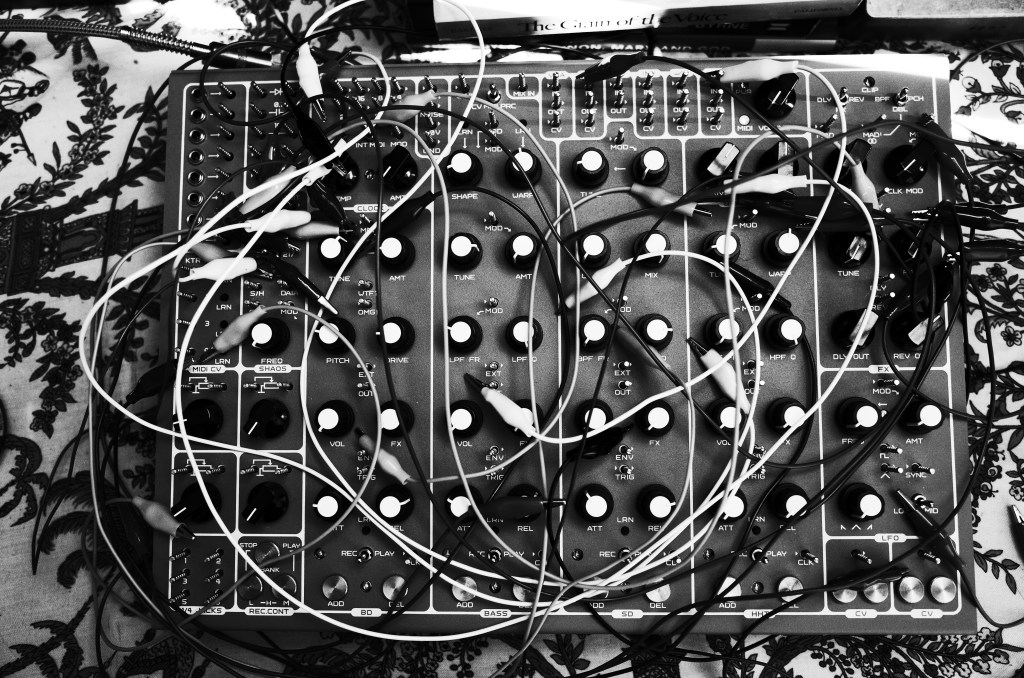
The first full compositions of this project, both pieces exemplify the rhizomatic nature of the PULSAR-23, continuing until I had used all 30 included alligator clips the physical limitations of hand-patching, embracing disruptions and solving problems through the instrument’s flexibility. This led to unexpected and often jarring compositional changes, and few, if any creative ‘dead-ends’. (Songs: Venice Ascending, In The Backyards of Ghosts)
D. Split-Hand Performance [Appendix A.3 – Split-Hand Performance]
By setting each side of the LYRA-8 (4 voices on the left, 4 voices on the right) with different Modulation and tuning settings, I was able to perform with different expressive capabilities: the left hand for more stable notes and moving coins if needed, the right hand for lead ideas and real-time modulation changes for further note changes and movement. (Song: A Thousand Sleepless Nights)
E. Chaos into Melody [Appendix B.5 – SHAOS, Attenuator and Voice]
The SHAOS module on the PULSAR-23, a sample and hold module outputting random data patterns, was used to create melodies by feeding it through an attenuator. Combined with cross-clocking, it allowed for complex patterns of melody, which through the attenuator, allows the data to be reduced or expanded as needed, decreasing or increasing the melodic steps respectively. (Songs: LSD in the Mail, Compton Avenue Hymns)
F. Diode Expression [Appendix B.6 – Clock, LFO, Diode and Voice]
Using the Diode module to combine different clock sources, which are then used as a trigger for a voice module such as bass drum or hi-hat, allows for different grooves and expression. By combining the 4 output of the clock, and the LFO output into the Diode module, the resulting signal can range from velocity providing ghost notes, disrupted patterns providing groove and micro-sound patterns providing small, glitchy barely-there notes. (Songs: Venice Ascending, Compton Avenue Hymns, Drive)
G. New Voices [Appendix B.7 – LFO and FX Voices]
Using the output of the LFO module and feeding it into the input of either the delay or reverb on the FX module, allowed for a voice that could be tuned in real-time through the LFO’s frequency control, in addition, using the tune function for the delay FX allows for further harmonic layering. This allows the creation of more voices in addition to the available 4 and allows for real-time performance through the LFO modules controls. This can be heard most explicitly in the second verse of ‘A Ragged Sigh’, with a real-time melody through the LFO and FX modules. (Songs: Venice Ascending, LSD in the Mail, A Ragged Sigh, In The Backyards of Ghosts)
H. Sustained Voices [Appendix B.8 – Cutting the Clock]
With Logic providing the tempo to the PULSAR-23, I was able to capture the ‘tails’ of recordings by unplugging the MIDI cable at specific moments to sustain voices and soundscapes. This allowed for more dynamic transitions between sections and added depth to the arrangement. (Song: In the Backyards of Ghosts)
I. Overloading the MIX IN Patch Point [Appendix A.4 – Overloading MIX IN]
Overloading the PULSAR-23’s MIX patch point by sending any voice module such as bass, snare, or another module like the LFO output causes rhythmic, ducking effects and causes unique textures as the signal fights itself as it distorts internally. (Song: In the Backyards of Ghosts)
J. Touch & Improvisation [Appendix B.9 – Performing the PULSAR- 23 and LYRA-8]
Hand-patching between the available patch-points on the PULSAR-23 allowed for a more reflexive and ‘performative’ approach to using the instrument. Using the CV touch control to send real-time modulation signals, as well as hands-on manipulation of available controls and patch-points encourages improvisation and enhances the connection between user and instrument.
4.3. Community Engagement
The role of community interaction and learning among SOMA users is critical to understanding the broader impact of unconventional instruments on electronic music composition. This section provides insights gathered from the survey data, emphasizing how community engagement shapes individual practices and fosters innovation.
Based on the survey responses, it is evident that platforms like Discord, YouTube, Instagram and online forums play a significant role in the users’ experience with SOMA instruments. For instance, ‘User U1’ mentioned, “I engage with the community through the Discord server, sharing tips and learning from others’ experiences.” This sentiment is echoed by ‘User U2’, who follows discussion on Discord and YouTube, and ‘User U6’, who participates in online forums and social media groups dedicated to experimental music and synthesizers.
These platforms provide users with a space to exchange ideas, techniques and feedback, which enhances and augments their creative process. The continuous interaction within these communities helps users stay updated with new methods and discoveries, facilitating a collaborative environment for learning and innovation. As ‘User U4’ pointed out, “I constantly learn something new and interesting from the community, particularly techniques for live performance and sound design.”
4.4. Collaboration
Collaboration among SOMA users also emerged as a theme. While some users, such ‘User U2’ and ‘User U6’ have engaged in collaborative projects. ‘User U3’ shared, “I performed a live set together with [redacted] using SOMA instruments,” highlighting how these instruments can bring musicians together, fostering a sense of community and shared creativity.
Additionally, ‘User U6’ mentioned participating in online jam sessions and contributing to compilation albums, demonstrating how digital platforms facilitate collaborative opportunities even across geographical boundaries. Such collaborations not only enhance individual creativity but also contribute to the collective evolution of musical practices within the community.
4.5. Learned Techniques
The survey data reveals that learning new techniques from the community is a common and valuable experience among SOMA users. For example, ‘User U1’ highlighted learning the “Diode module trick on YouTube,” (Conatus Modulari, 2024) which significantly enhanced their approach to envelope generation and groove using a combination of clock sources in a ‘circuit- bend’ style approach through the Diode module on the PULSAR-23. Similarly, ‘User U4’ emphasized the importance of community-driven learning, constantly picking up new techniques for live performance and sound design.
These insights underscore the community’s role in promoting continuous learning and experimentation. The shared knowledge within these networks enables users to expand their creative horizons and develop innovative approaches to using SOMA instruments, and in their own compositions and performances. ‘User U5’ experienced learning about routing different sounds and creating layered textures from the community, further illustrating the practical benefits of this collective knowledge-sharing.
4.6. Listener Feedback and Implications for Compositional Practice
The audience’s initial reactions to the compositions were generally positive, marked by a sense of intrigue and engagement. Many listeners were captivated by the unconventional sounds and structures, which successfully held their attention and sparked curiosity. The unpredictability and extensive use of instruments led to moments of surprise, further maintaining their interest throughout the listening experience.
Key elements of the compositions, such as rhythmic complexity and unique sound textures, were particularly appreciated. The intricate rhythms generated by the PULSAR-23 stood out as a significant point of interest, while the LYRA-8’s distinctive timbres added depth to the overall sound. These qualities not only drew listeners in but also evoked vivid visual and emotional responses, enhancing their overall experience.
While the experimental and improvisational nature of the music was well- received, some listeners expressed a desire for more structured melodic interactions within the compositions. They appreciated the balance between exploration and form, suggesting that integrating more defined melodies could further enhance the emotional impact of future works. Additionally, the feedback indicated a potential to explore the contrast between human and machine elements, as some listeners sought a more pronounced human touch within the compositions.
These insights suggest that while the innovative use of rhythm and texture should remain a focus, there is room to refine the balance between structure and improvisation. Future compositions can benefit from incorporating more melodic content and emphasizing the interplay between human expression and electronic innovation, creating works that resonate on both an emotional and intellectual level.
4.7. Closing Remarks
The exploration of unconventional instruments, specifically the PULSAR-23 and LYRA-8, has greatly impacted my music composition process. By moving away from traditional DAW-centric workflows, these instruments facilitated a more intuitive and exploratory approach, leading to creative breakthroughs previously constrained by conventional methods.
The thematic analysis of listener feedback underscored the significance of rhythmic and melodic elements, as well as the music’s ability to evoke vivid imagery and emotional responses. These insights not only inform my future compositions but also offer a potential roadmap for other composers. Embracing unpredictability and fostering a hands-on emotional connection with instruments can unlock new creative potentials and deepen musical engagement.
Additionally, the process of defamiliarization with the PULSAR-23 and LYRA- 8, though initially disorienting, enhanced my connection with the music and the instruments. This approach aligns with the hands-on, intuitive philosophy discussed with Lundberg. The thematic analysis also revealed that the modular nature of these instruments supports exploratory, non-linear composition. Applying Rhizome Theory, the instruments encourage a decentralized creative process where multiple ideas can flourish simultaneously and interact in unexpected ways.
Overall, this journey highlights the importance of community interaction and openness to new methods. Engaging with innovative techniques and like- minded musicians can lead to enriching practices that advance the electronic music landscape. These findings reinforce the value of exploring the unfamiliar and embracing the unexpected to fuel creativity.
 thought_scores